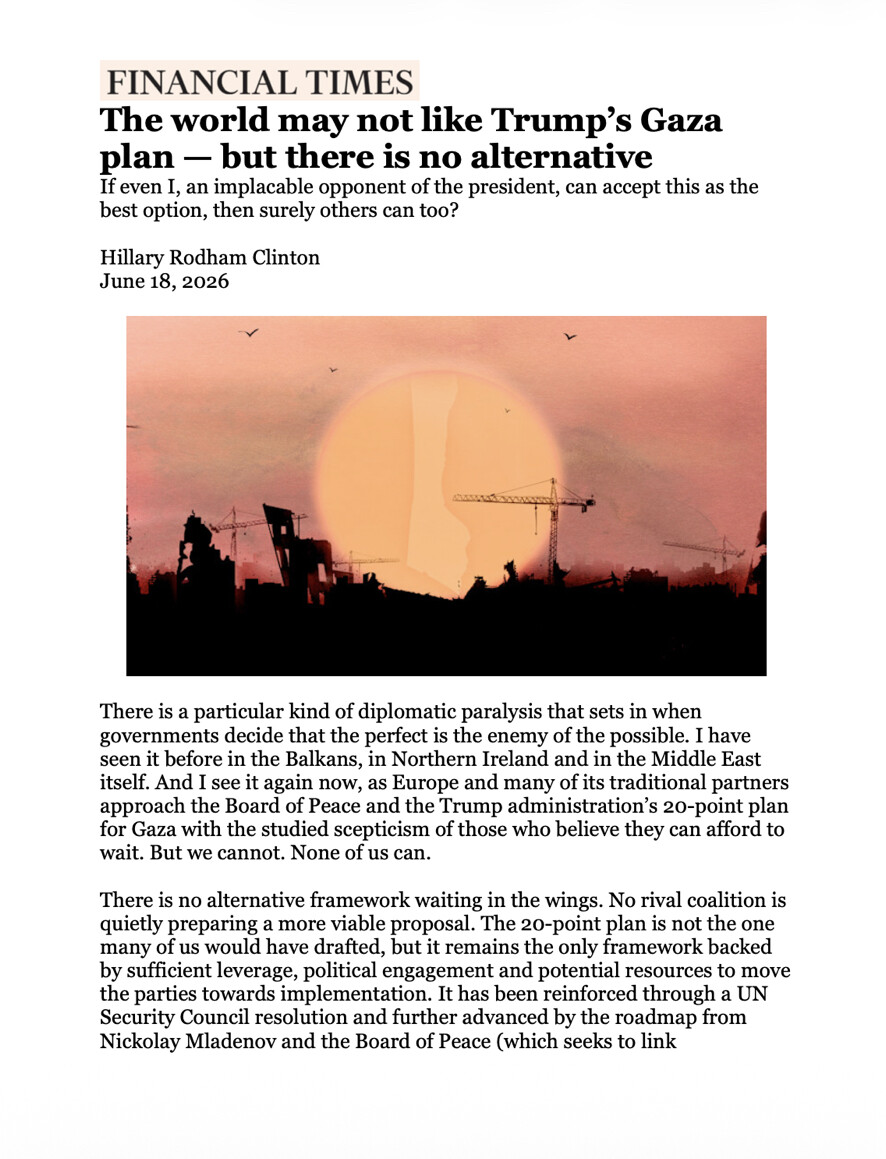
Trump Highlights Clinton’s Endorsement of His 20-Point Gaza Plan
Trump amplifies a Financial Times op-ed in which Hillary Clinton, a former secretary of state and self-described implacable opponent, calls his Gaza framework the only viable option.

WASHINGTON D.C. — Donald Trump amplified a rare cross-partisan endorsement of his Gaza framework, sharing a Financial Times op-ed in which Hillary Clinton called the plan the only viable path forward.
Clinton, a former U.S. secretary of state and professor at Columbia SIPA, wrote that the administration’s 20-point plan is not the framework she would have drafted. It remains the sole option backed by sufficient leverage and engagement to move the parties toward implementation, according to the Financial Times piece Trump shared by mentioning the source (see ft).
“Yet if even I, an implacable opponent of President Trump, can accept that this is the best option in a terrible situation, then surely others can too?” Clinton wrote in the essay.
The endorsement strips a signature Trump initiative of its partisan framing. It gives European governments and regional partners political cover to engage a plan many have approached with what Clinton described as studied scepticism.
Here is the full post on truthsocial: “Hillary Clinton: “The world may not like Trump’s Gaza plan — but there is no alternative: If even I, an implacable opponent of the president, can accept this as the best option, then surely others can too?”” on August 9, 2026 at 12:51 PM ET.
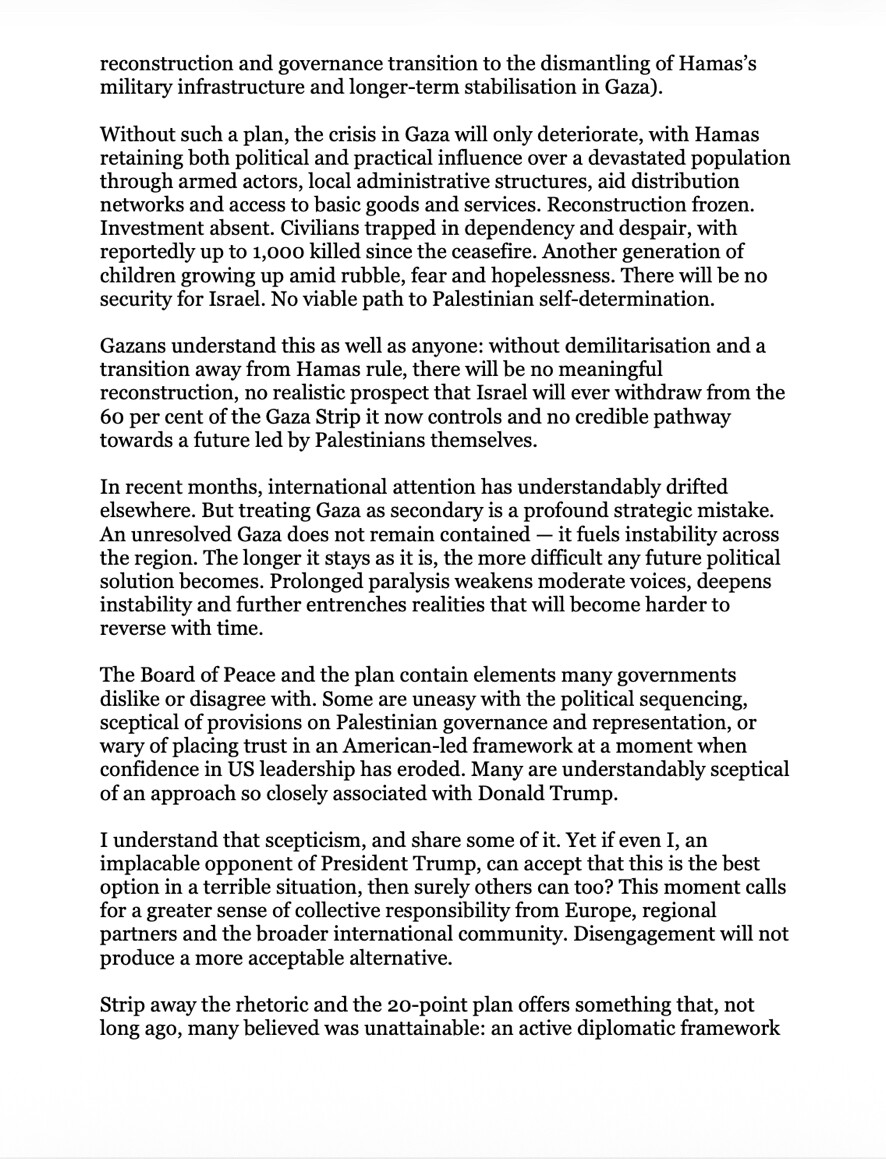

President Donald J. Trump posted a screenshot of a Financial Times op-ed at WASHINGTON D.C.
© copyright Zenger.News
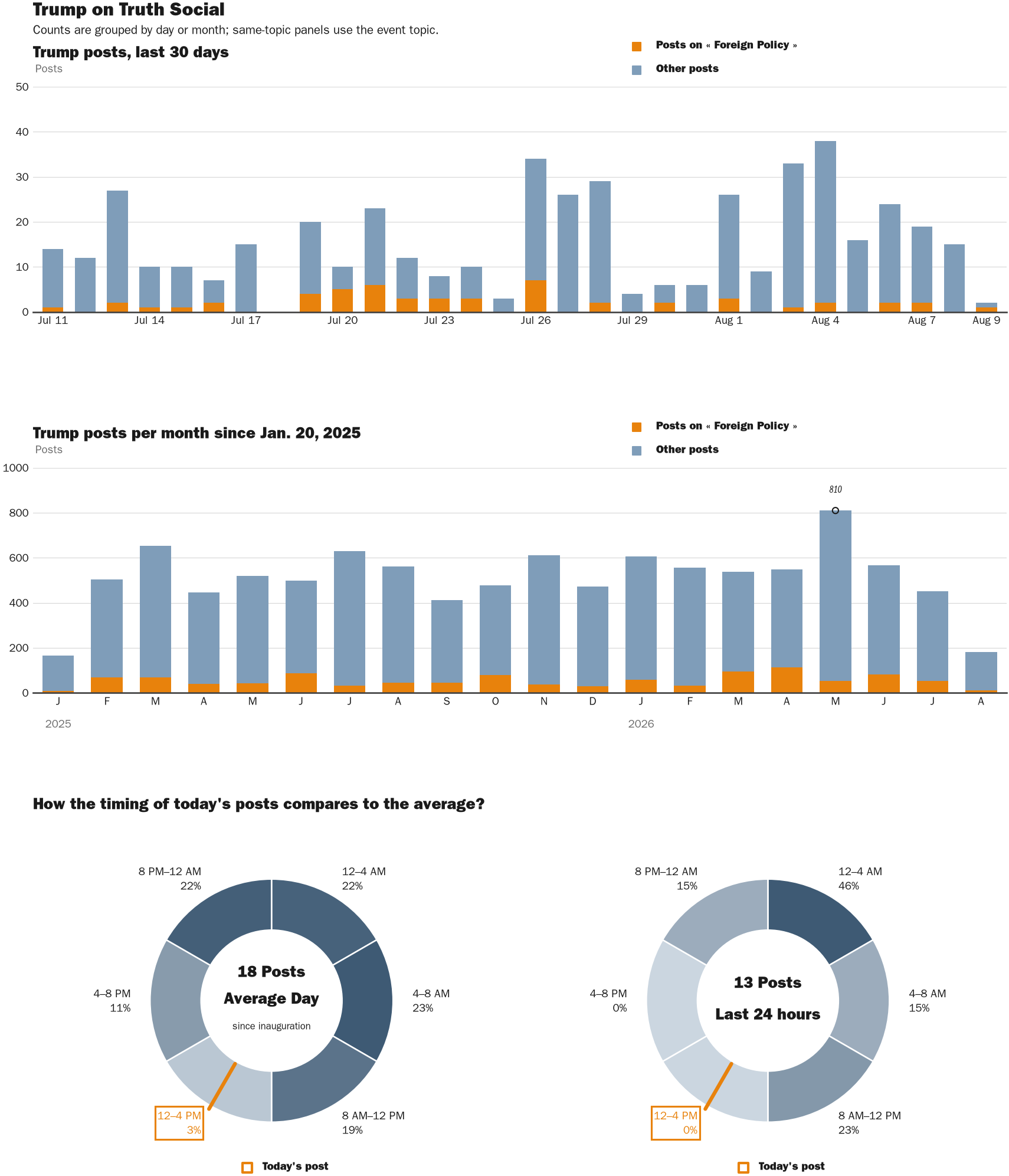
This is Trump’s second message released today, and the last post was three hours ago, and it is not part of a thread. On average, Trump produces 18 posts per day since his inauguration on January 20, 2025. The move fits a broader pattern in Trump’s recent messaging, with 54 of his 489 posts over the last 30 days classified as Foreign Policy posts.
Clinton argued that no rival coalition is quietly preparing a more viable proposal. A United Nations Security Council resolution and a roadmap from Nickolay Mladenov and the Board of Peace have reinforced the framework. That roadmap seeks to link reconstruction and governance transition to the dismantling of Hamas’s military infrastructure. The plan aims to stabilize a devastated population while shifting authority away from Hamas.
The stakes fall heaviest on Gaza’s civilians and on Israel’s security calculus. Without demilitarization and a transition away from Hamas rule, Clinton wrote, there would be no meaningful reconstruction and no realistic prospect that Israel will withdraw from the 60 percent of the Gaza Strip it now controls. She cited reports of up to 1,000 people killed since the ceasefire. Reconstruction remains frozen and investment absent, she wrote, warning that another generation of children risks growing up amid rubble.
For the average American reader, the plan represents Washington’s attempt to convert a costly conflict into a managed political process. A stalled Gaza fuels regional instability, draws in U.S. diplomatic and military resources, and keeps energy markets and allied relationships under strain.
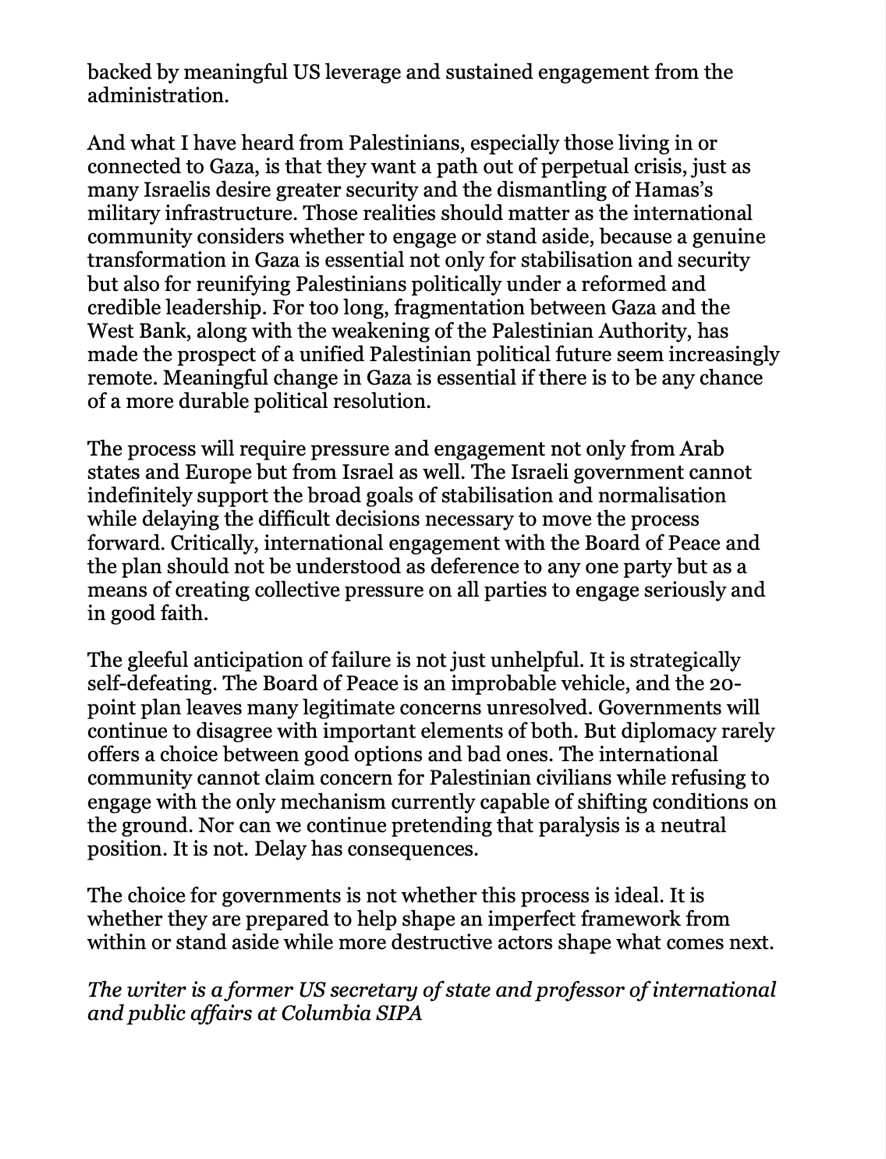
Former President Donald J. Trump posted a screenshot of text from a Financial Times op-ed on Truth Social at WASHINGTON D.C.
© copyright Zenger.News
Cross-partisan backing for a sitting president’s foreign policy has happened before. Democratic and Republican figures aligned behind the 1995 Dayton Accords that ended the Bosnian war, a Balkans settlement Clinton referenced directly in her essay. Bipartisan support also underpinned the Good Friday Agreement in Northern Ireland in 1998, another conflict she invoked as evidence that imperfect frameworks can still hold.
The next moves rest with European governments, Arab states and the Israeli government, which Clinton said must all apply pressure through the Board of Peace. A specific date for their collective decision on deeper engagement has not been announced.
Brokering peace in the Levant has drawn American presidents into high-stakes gambles before. Jimmy Carter convened Egyptian President Anwar Sadat and Israeli Prime Minister Menachem Begin at Camp David in September 1978, producing accords that led to a 1979 treaty and a Nobel Peace Prize for the two leaders, according to britannica.com. Militants opposed to that peace assassinated Sadat three years later, in October 1981, a reminder that even successful frameworks can exact a lasting price on those who champion them.
NewsFindr Chart Maker
Photo by Zenger real-time database of all Truth Social posts.
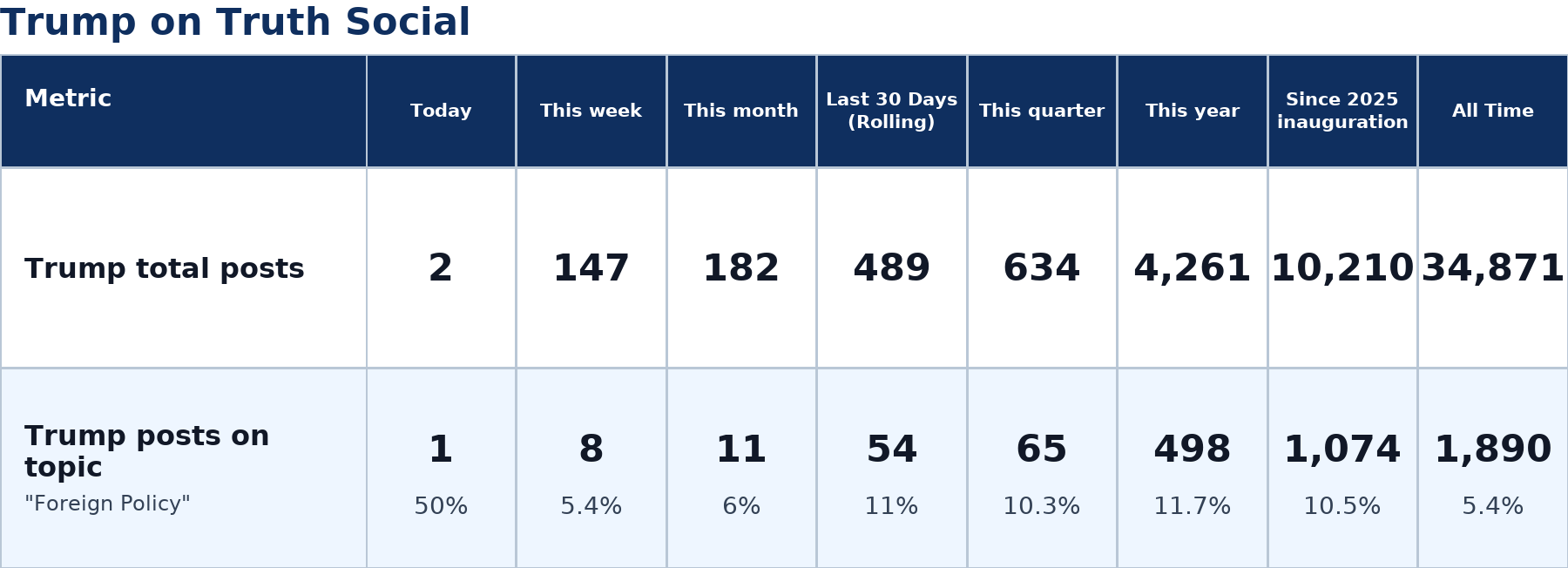
Zenger analysis
Photo by Zenger analysis
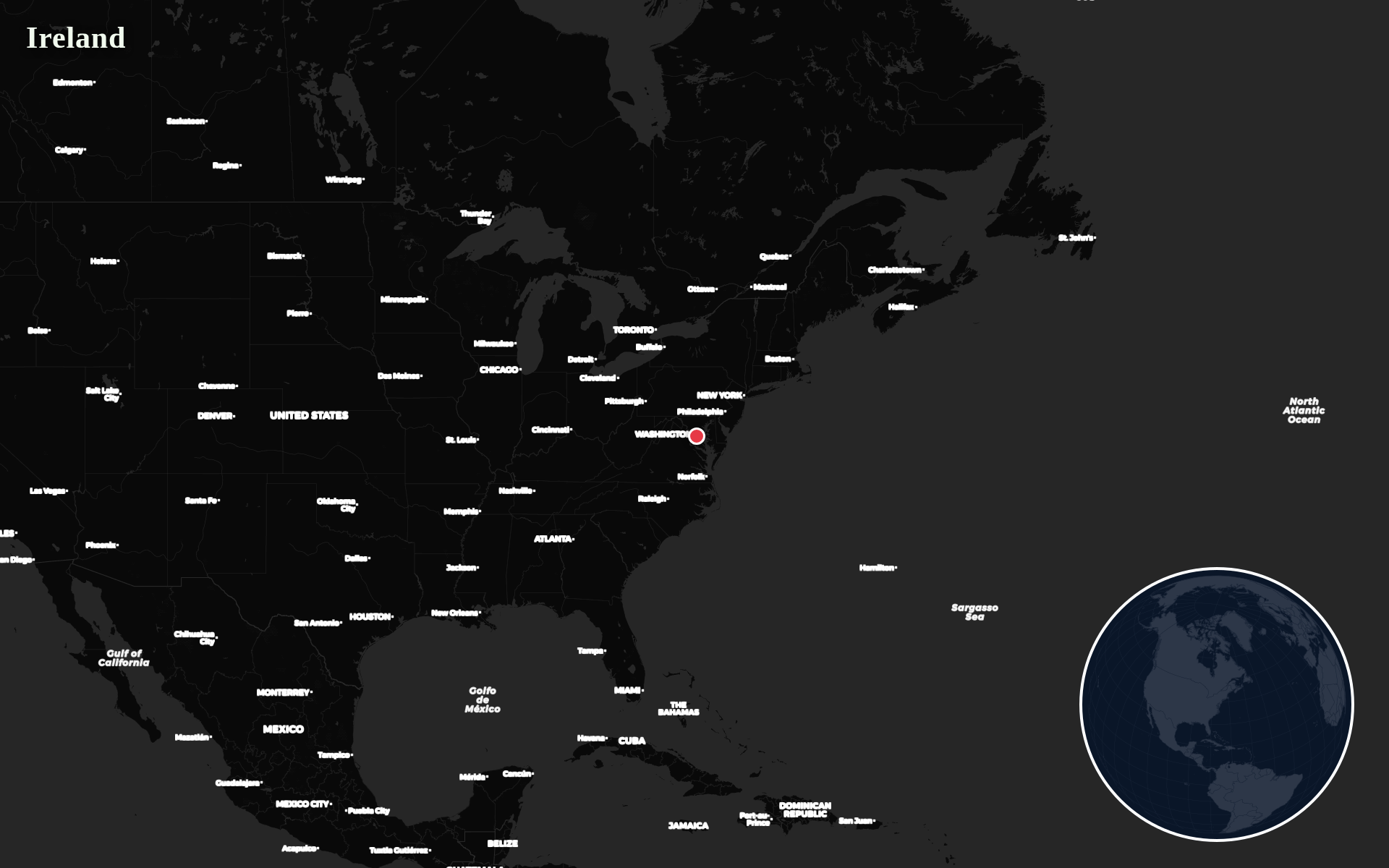
Protomaps / Natural Earth – Ireland
Photo by Protomaps / Natural Earth – Ireland
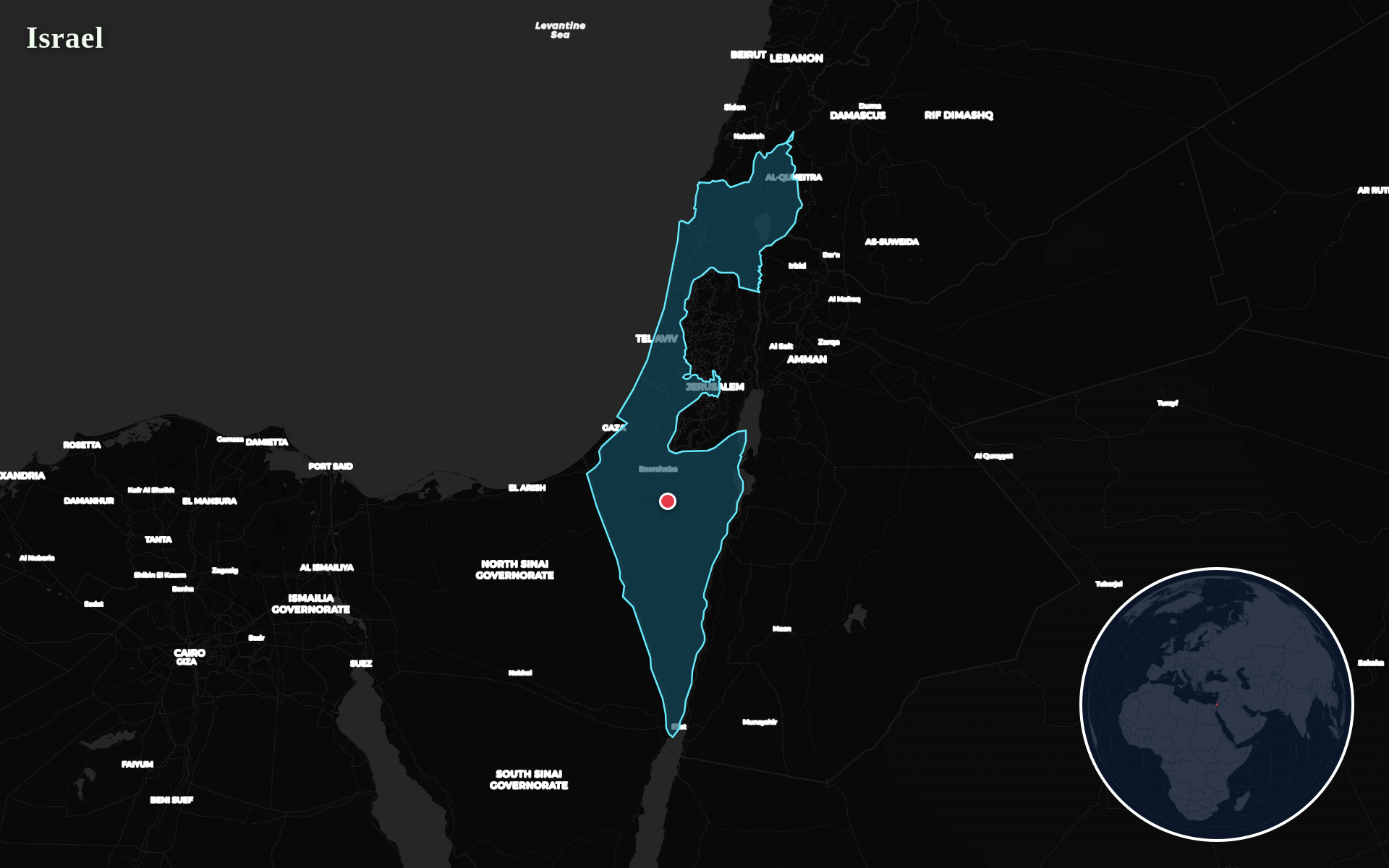
Protomaps / Natural Earth – Israel
Photo by Protomaps / Natural Earth – Israel