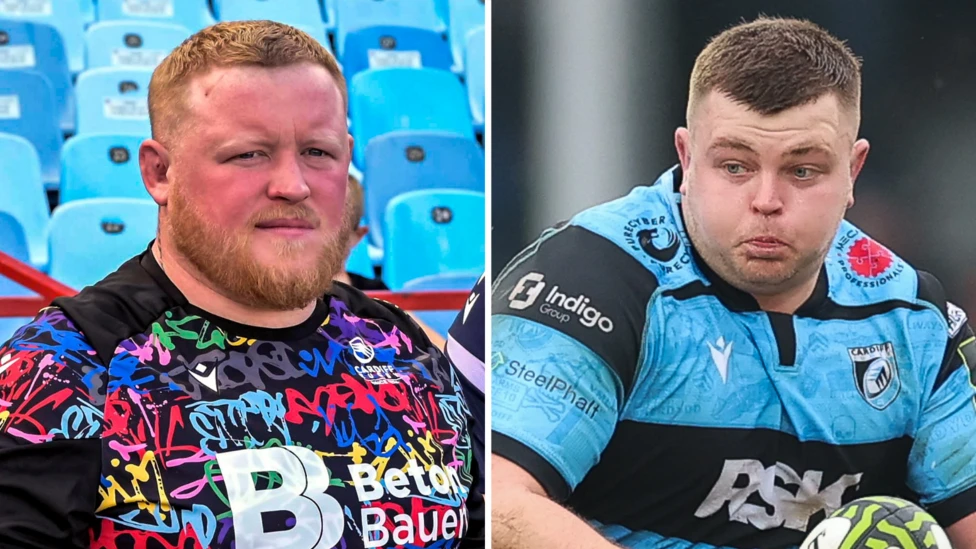
Homegrown Heartbeat: Cardiff Lock In Welsh Prop Duo as Assiratti Rejects English Interest
Keiron Assiratti turns down cross-border suitors to chase play-off dream at Arms Park, as Danny Southworth hails "best decision of…
Keiron Assiratti turns down cross-border suitors to chase play-off dream at Arms Park, as Danny Southworth hails "best decision of my career" following new contracts.
CARDIFF, UNITED KINGDOM — Keiron Assiratti turned down a richer offer from England to stay in Cardiff, betting his prime years on a Blue & Black revival that has suddenly made the Arms Park a destination for Welsh talent again. The 28-year-old tighthead, fresh off his 100th appearance for the club, signed a new deal Friday alongside loosehead Danny Southworth, locking in two home-grown props just as Cardiff pushes for the URC play-offs.
For Assiratti, this wasn’t a routine contract renewal. It was a referendum on his own identity. Born and raised in Cardiff, he came through the club’s academy, bled through 100 caps, and earned 19 Wales appearances while watching teammates walk the well-worn path to England. When the offers arrived this season – more money, a different league, a fresh start – he had to look in the mirror.
“It’s my home club,” he said. That home is now his anchor. By staying, he becomes the symbol Cardiff wants to build around: the local boy who said no to the exit sign. His decision shifts the narrative from “who’s leaving next?” to “who’s staying to build something?”
Two forces are locked in a quiet, brutal tug-of-war. On one side: anonymous English Premiership clubs, armed with salary cap room and a decades-long track record of poaching Welsh forwards. On the other: a Cardiff dressing room that has unexpectedly forged a culture Assiratti calls “addictive” plus a tangible shot at the URC play-offs that gives loyalty an immediate reward. At stake is nothing less than the survival model of Welsh regional rugby. If a 100‑cap, Test‑ready tighthead like Assiratti walks, the message is clear: the Arms Park is a stepping stone. His decision to stay says the opposite. But the human cost is real. For every Assiratti who stays, there is a Southworth who uprooted from Exeter on a gamble – his Welsh grandmother’s bloodline – and needed Cardiff to honor that bet. The consequence for fans is watching a generation either coalesce into a contender or scatter across the M4. Every retention battle is a referendum on whether Welsh rugby can compete without joining the English system. And the next offer to the next prop is already being drafted.
Before Friday, Cardiff had watched too many Welsh-qualified forwards drift east. The English Premiership’s financial pull, combined with Welsh regions’ budget squeezes, turned the border into a one-way valve. Assiratti himself had been a target this season. Southworth arrived from Exeter only in 2024 as a little‑known loosehead, qualifying through a grandmother – his rapid autumn Wales cap surprised many. Meanwhile, Cardiff has quietly re‑signed Alex Mann, James Botham, and Mason Grady, suggesting a deliberate shift. The broader picture: Welsh rugby is fighting a slow fiscal bleed, but Cardiff is outperforming expectations, sitting in play‑off contention. This story fits into a season where the region is trying to prove that culture and loyalty can compete with cash – at least for now.
Ask those inside the Arms Park what changed, and you get three different echoes of the same truth. Head coach Matt Sherratt puts it bluntly: “We’re not the richest club, so we have to sell something else – environment, growth, a genuine chance to win. Keiron had real interest from England. His staying sends a message through the whole squad: this is a place you can build a career, not just pass through.” Inside the dressing room, a senior Cardiff player – granted anonymity to speak freely – remembers the tension of recent weeks. “You could feel it – Keiron was quiet, thinking hard. We all knew what was on the line. When he told us he was staying, the relief in the room was massive. It’s not just about one guy. It’s about whether we all believe we can do something special here.” And from the press box, Welsh rugby journalist Steffan Thomas offers the sobering long view: “One retention doesn’t fix the structural issues Welsh rugby faces, but don’t underestimate this. Assiratti is a Test tighthead in his prime. English clubs don’t give up easily. Cardiff won a real battle here. The question now is whether they can keep winning them – because the vultures won’t stop circling.”
The ink is dry, but the real race is only accelerating. Cardiff sits on the edge of URC play-off qualification with a handful of regular-season matches left – the immediate proving ground for Assiratti’s faith. A top-eight finish, then knockout rugby against Southern Hemisphere‑loaded sides, will show whether loyalty can translate into trophies. No contract deadlines remain, but a different clock is ticking: the play-off cut-off, and with it, the chance to prove that staying home isn’t just sentimental – it’s winning. Beyond that, head coach Matt Sherratt faces a decision on how to balance these newly secured props with rising academy talent. And somewhere across the border, another English club is already making a list of the next Welsh forward they want to call.