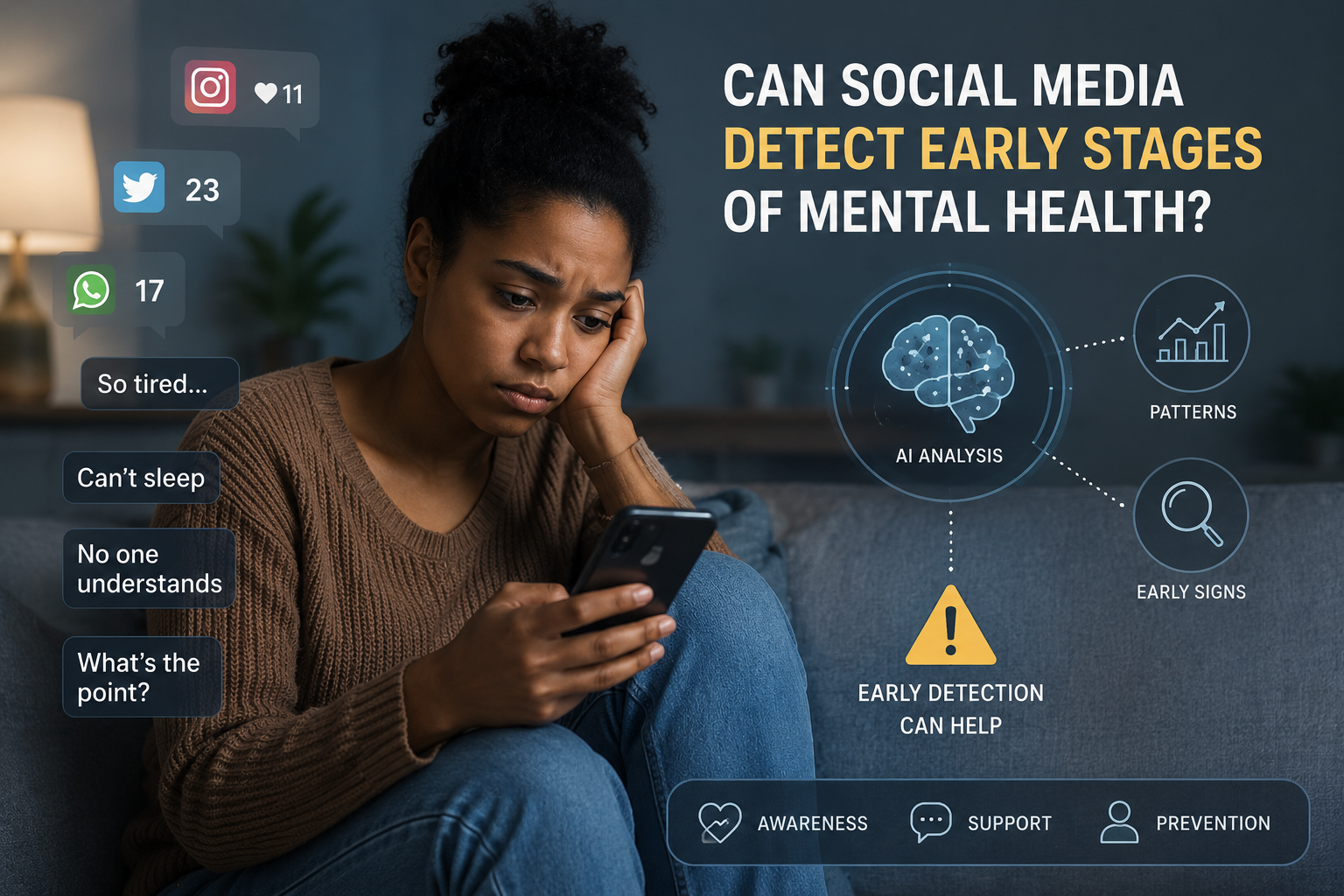
Can Social Media Detect Mental Health Struggles Early?
Researchers and psychologists are exploring how changes in online behavior, posting patterns, and emotional language on social media may help identify early signs of anxiety, depression, and emotional distress before they escalate.
Researchers and psychologists are exploring how changes in online behavior, posting patterns, and emotional language on social media may help identify early signs of anxiety, depression, and emotional distress before they escalate.

NEW YORK — On a quiet evening in Nairobi, a university student keeps scrolling through her phone, but something has changed. She is posting less, her captions have become shorter, and she has not replied to close friends in days.
To a human, it might look like exhaustion or a busy week, but to emerging artificial intelligence systems, these small shifts in tone, timing, and engagement are the kinds of signals now being analyzed for possible signs of anxiety, depression, or loneliness.
Across research labs and technology companies, computers are being trained to notice patterns that most people would miss, fewer posts than usual, a drop in emoji use, more negative wording, or sudden withdrawal from online conversations. As one researcher explains:
“Small changes in digital behavior, when tracked over time, can sometimes reflect shifts in emotional well-being, even before a person realizes they are struggling.”said Jonathan Haidt.
These tools are designed to catch emotional distress early, before it deepens into something more severe. But as they grow more sensitive, they also raise difficult questions about whether a change in someone’s online behavior is a warning sign of illness or simply a normal part of being human.
jonathan haidt is a leading voice studying how smartphones and social media are reshaping young people’s mental health, and his own work is increasingly shaped by the same fast-moving digital environment he analyzes.
As a professor and author, he operates in an attention-driven online space where research on issues like teen anxiety, sleep disruption, and shrinking attention spans is quickly amplified, debated, and sometimes misinterpreted across platforms such as X (formerly Twitter). Instead of slow academic dialogue, he now responds to real-time public discussions and viral concerns as they emerge, creating a feedback loop where his research both examines and reacts to the pressures of constant connectivity.

The strongest evidence for this trend comes from large-scale meta-analyses and computational studies showing measurable links between digital behavior and mental health outcomes, though the effects are nuanced rather than uniform. This is reinforced by broader umbrella reviews concluding that the overall relationship between social media use and mental health is mixed but leans negative in high-intensity usage groups, suggesting that risk is concentrated among heavy users rather than all users.
At the same time, computational studies such as the one at show that mental health states such as depression can be inferred from patterns in online language and behavior on platforms like Reddit, where changes in word choice, posting frequency, and emotional tone form detectable signals of psychological distress. Together, this body of evidence suggests a two-layer finding: first, that extreme or dysregulated digital engagement correlates with worse mental health outcomes at a population level, and second, that online behavior itself can serve as a measurable proxy for underlying mental health conditions.
However, researchers also caution that these are largely correlational relationships influenced by confounding factors, such as pre-existing anxiety, social environment, and offline stressors, meaning the data supports association and prediction rather than simple one-way causation.
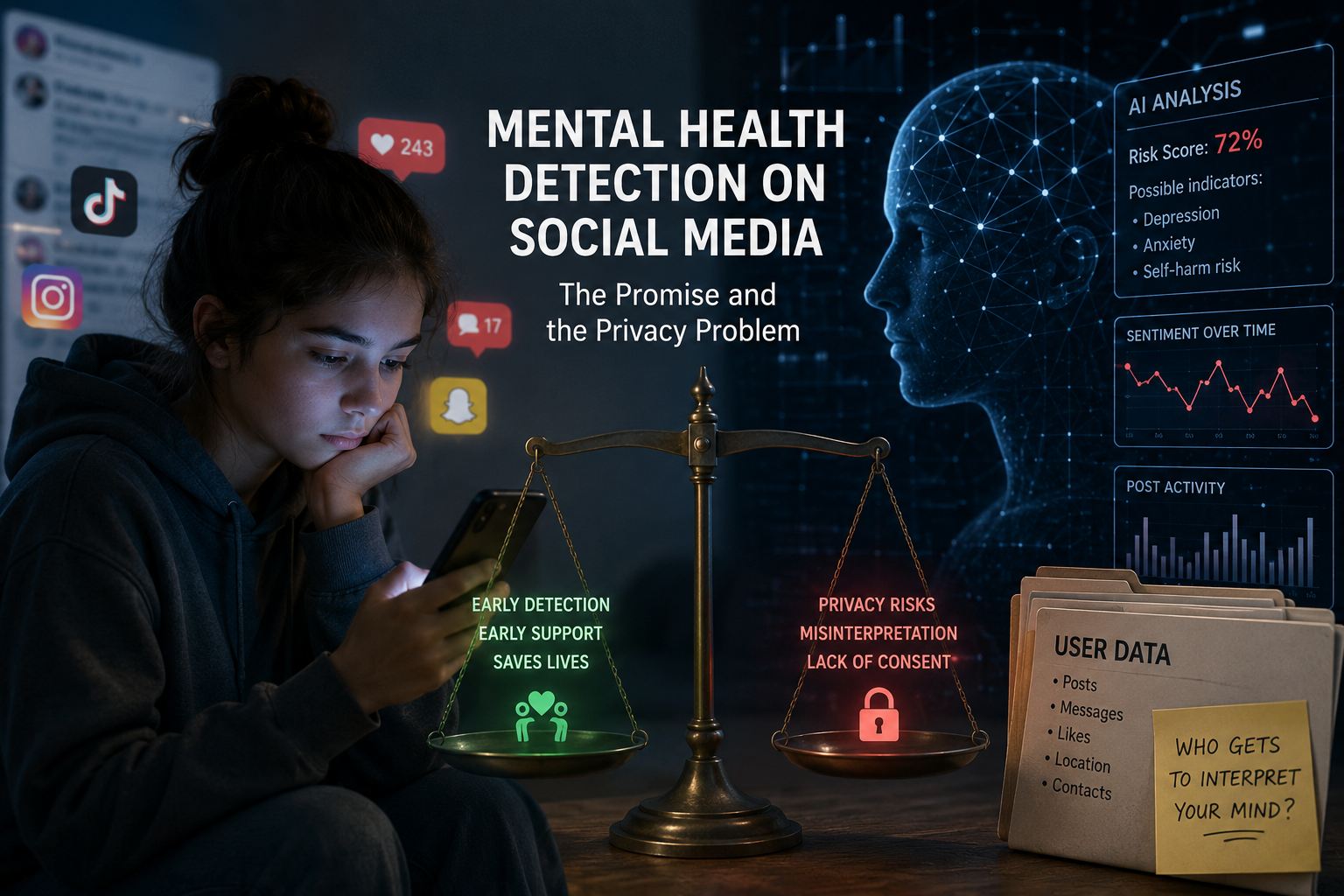
The push to use social media data for mental health detection is shaped by a sharp tension between innovation and privacy, with clear groups both driving and resisting the trend. On one side, researchers in computational psychiatry, public health institutions, and digital health startups argue that analyzing online behavior can help identify early warning signs of depression, anxiety, or self-harm risk at scale, especially for people who never access traditional mental health services.
Studies in computational linguistics and digital psychiatry show how language patterns, posting frequency, and emotional tone on platforms like Reddit can be used to model psychological states, suggesting real potential for earlier intervention and population-level monitoring.
On the other side, privacy advocates, digital rights organizations such as the Electronic Frontier Foundation, and some clinicians strongly push back, warning that these systems turn personal expression into passive surveillance, often without meaningful consent, and that algorithmic interpretation of language is highly prone to misreading context, culture, and sarcasm, leading to false positives and harmful labeling. Even within psychology and psychiatry, skepticism remains about whether noisy, context-poor digital traces can validly substitute for clinical evaluation.
This creates a real-world conflict of interests: technology firms and data-driven health researchers benefit from access to massive behavioral datasets that improve predictive tools and commercial products, while users, especially vulnerable individuals, bear the risk of misinterpretation, privacy loss, and unintended profiling, making the trend not just a technical advancement but a contested ethical battleground over who gets to interpret human behavior and for what purpose.
This debate over using social media data for mental health detection is shaped by decision-makers, eyewitnesses, and experts who each reveal a different side of the conflict. Policymakers and regulators are under pressure to decide whether platforms can use behavioral data for mental health prediction, balancing innovation against privacy concerns raised by digital rights groups. On the ground, clinicians and school counselors act as eyewitnesses: some say online signals can help identify struggling students earlier, while others warn that normal behavior is often misread as clinical risk.
Looking ahead, the trend is moving toward more integrated digital mental health monitoring in platforms, schools, and wearable technologies, making early detection more common but also expanding surveillance. The key issue is where society draws the line between useful prediction and intrusive monitoring, and whether people will know when their everyday online activity becomes a mental health signal.