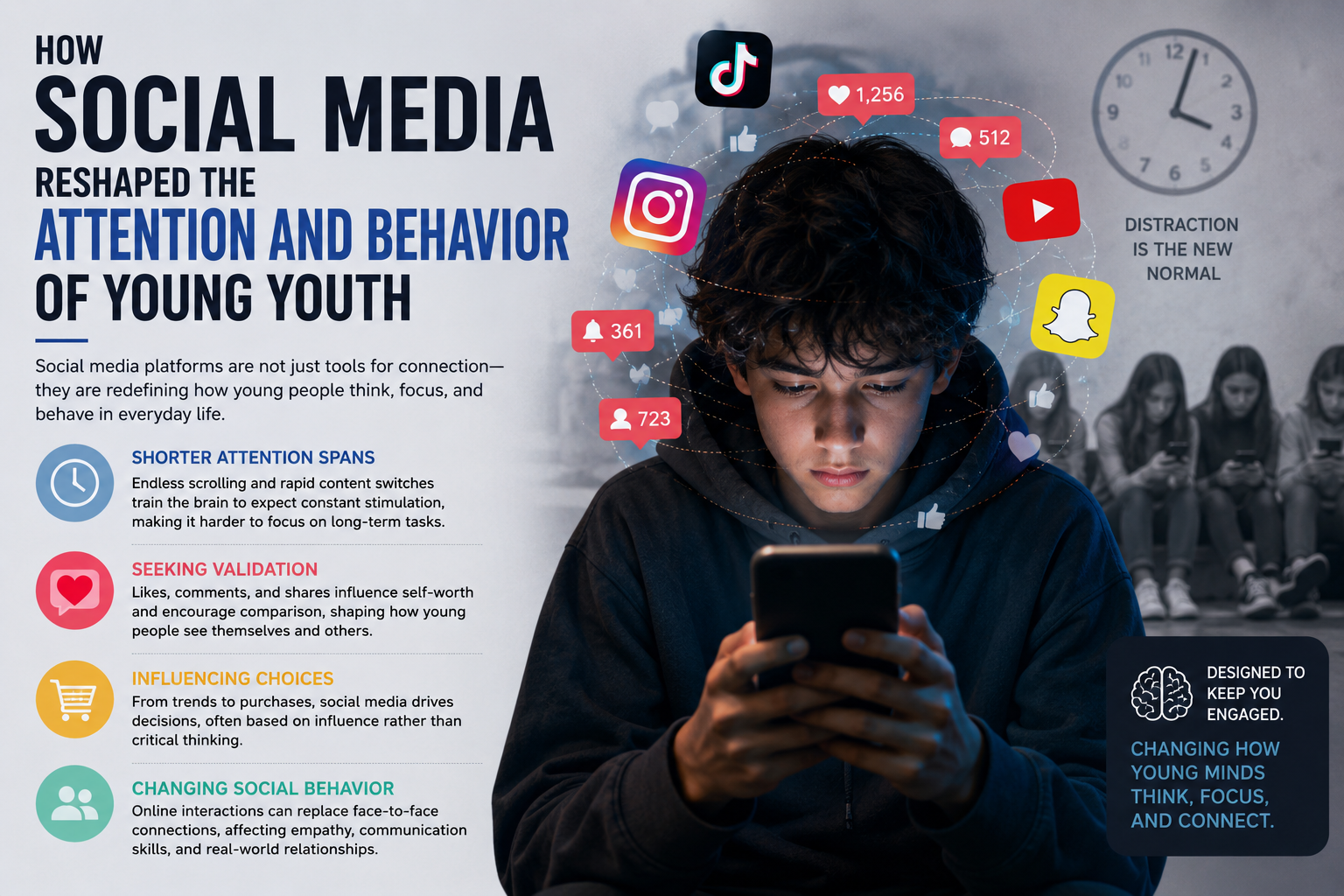
How social media is reshaping the attention and behaviour of young people.
Researchers warn that constant scrolling may be reshaping attention and communication in youths.
Researchers warn that constant scrolling may be reshaping attention and communication in youths.

NEW YORK — As social media platforms continue to dominate daily life, many young people are finding it increasingly difficult to stay focused for long periods without checking their phones. In schools and homes alike, teachers and parents say constant exposure to short videos, trending content, and endless notifications is changing the way teenagers communicate, study, and behave around others.
“You might be reading and then have a certain urge to use Instagram and TikTok without knowing”, says Jean Twenge.
Jean Twenge has spent years studying how smartphones and social media are reshaping the lives of young people, turning what was once a growing concern into a major focus of her research and writing. As a psychology professor, Twenge says she began noticing dramatic behavioural changes among teenagers as screen time increased and face-to-face interaction declined. Through interviews, surveys, and studies, she observed that many young people were sleeping less, struggling to concentrate for longer periods, and spending more time online than engaging in real-world activities. Her work reflects a broader global trend in which social media has become deeply woven into the routines of teenagers and young adults, influencing how they communicate, study, socialise, and see themselves. While platforms like TikTok, Instagram, and Snapchat offer entertainment and connection, Twenge warns that excessive use may also contribute to distraction, anxiety, and reduced attention spans, especially among young users growing up in a constantly connected digital environment.


The power Of Social Media
Research by Jean Twenge and other mental health experts suggests that the rapid rise of smartphones and social media has coincided with growing attention and behavioural challenges among young people. One widely cited study found that teenagers who spent seven or more hours a day on screens were more than twice as likely to experience anxiety or depression compared to those with lower screen time, while additional studies published in journals such as Nature Human Behaviour linked heavy digital media use to poor sleep, reduced emotional well-being, and increased difficulty concentrating among adolescents. Large-scale surveys conducted in the United States and the United Kingdom also found that increased social media use was associated with lower psychological well-being, particularly among teenage girls, as researchers warned that excessive online engagement may reduce face-to-face interaction and shorten attention spans.
While researchers like Jean Twenge warn that excessive social media use may be weakening attention spans and affecting how young people communicate, many technology companies and young users continue to defend these platforms as essential tools for connection, entertainment, learning, and business opportunities. Social media companies benefit from longer screen time and constant engagement, while influencers, online businesses, and content creators rely on these apps for income and visibility.
At the same time, parents, teachers, and mental health experts are increasingly pushing back, arguing that endless scrolling, short-form videos, and nonstop notifications are making it harder for teenagers to focus in classrooms, maintain healthy sleep patterns, and build real-life social skills. This growing tension among the convenience of digital connection and concerns over declining concentration and emotional well-being has turned social media from a simple communication tool into a wider debate about how technology is shaping the behaviour of an entire generation.
The story is brought to life through three key perspectives that show the different sides of the issue. Jean Twenge provides the expert view, drawing on research into how smartphones and social media may be reshaping attention, behaviour, and mental health among young people, especially as screen time continues to rise. A teacher or parent adds a real-world perspective by describing what is happening in homes and classrooms, where students are often more distracted, less focused on long tasks, and increasingly dependent on their phones for communication and entertainment.
In contrast, a young social media user or content creator offers the lived experience of someone who benefits from these platforms through connection, creativity, and opportunity, but also feels the pressure of being constantly online and engaged. Together, these voices help present a balanced and human picture of a trend that is both shaping and dividing today’s digital generation, raising a bigger question of whether future societies will learn to control technology or will technology control them.