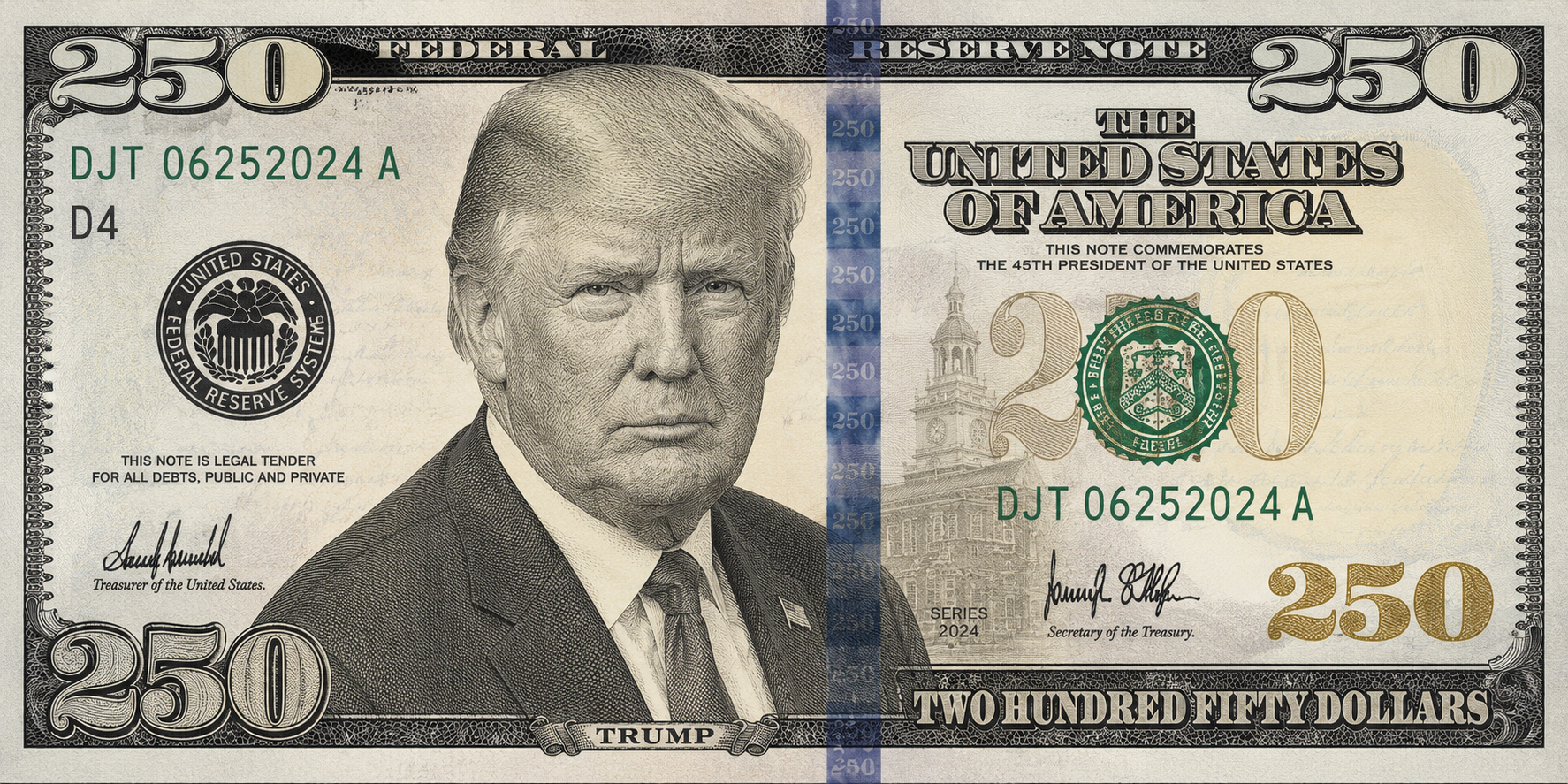
Trump Wants His Face on $250 Bill, Bypassing Tradition

WASHINGTON — The Trump administration is reportedly pressuring the Bureau of Engraving and Printing in Washington, D.C., to design a $250 bill with Trump’s portrait, a move that would make him the first living person to appear on U.S. currency in more than 150 years.
According to President Donald Trump, the $250 bill is more than a piece of currency. It’s part of his ongoing effort to cement his political legacy and public persona in American history. His supporters see it as an acknowledgment of a leader they believe remade American politics, while critics see it as an unprecedented effort to personalize national institutions around one living person.
Trump’s role turns the story into a bigger debate about power, symbolism, and influence. His fan base views pride and patriotism in honoring him on U.S. currency, but opponents fear the proposal muddies the line between public service and personal glorification. The controversy shows how a single politician can split public opinion and frame the debate about democracy, tradition, and national identity.
The political clash is between Donald Trump and his administration and critics, historians, and defenders of long-standing American political traditions. Trump allies argue his impact on U.S. politics and the economy is worthy of historic recognition, and the proposed $250 bill would be a patriotic tribute to a transformational leader. Nonetheless, critics see it as an effort to elevate a living president over democratic standards and transform national icons into political branding devices.
What is at stake is the neutrality and meaning of American institutions. U.S. currency has always stood for the whole country, not just particular political movements. Critics fear that placing a living political figure on money could weaken traditions meant to prevent personality-driven politics and further deepen political polarization.
Why should Americans care? Because national symbols affect public trust and collective identity. Currency is handled by millions of citizens every day and represents shared history and values. If political leaders begin to use those symbols to create personal legacy or partisan loyalty, it could undercut trust in the independence of government institutions and further divide an already polarized country.
The proposal comes amid debate over Donald Trump’s effect on American politics and institutions since he returned to office. In the past, U.S. money has depicted dead historical figures, not living political leaders, because the idea is to keep national symbols out of partisan politics. The reported push for a Trump-branded $250 bill is part of a larger climate of political polarization, where questions about presidential power, legacy, and the use of government institutions for political image-building still dominate the national debate.
“Critics say national symbols should go beyond partisan politics. They also ask if honoring an incumbent political figure could deepen political divisions and establish a new precedent for future leaders.”
The story makes readers question the use of taxpayer resources and government institutions. If the Bureau of Engraving and Printing goes ahead with a new $250 bill with Donald Trump, taxpayers could eventually pay for research, design, manufacturing changes, and perhaps circulation planning. Critics might question whether public agencies should focus on politically symbolic projects rather than core public responsibilities.
The proposal also raises accountability issues of political influence over traditionally nonpartisan institutions. Observers will question whether federal agencies are acting independently or under political pressure from the administration. The other questions are whether Congress would have to approve such a change, what legal or ethical standards apply to putting a living president on currency, and whether national symbols are being used to advance a personal political legacy rather than the public interest.
What happens next will depend on whether the Treasury Department and the Bureau of Engraving and Printing formally go forward with the proposal. Any change to U.S. currency would likely undergo legal review, public scrutiny, and even possible congressional involvement before it becomes official policy.
In the weeks to come, everyone will be watching to see whether the administration will make a formal request, whether lawmakers will back or oppose the idea, and how the public feels about the idea of a living president appearing on American currency. The proposal has already ignited a broader discussion over presidential sway, political symbolism, and the function of government institutions—a discussion that is unlikely to subside anytime soon.