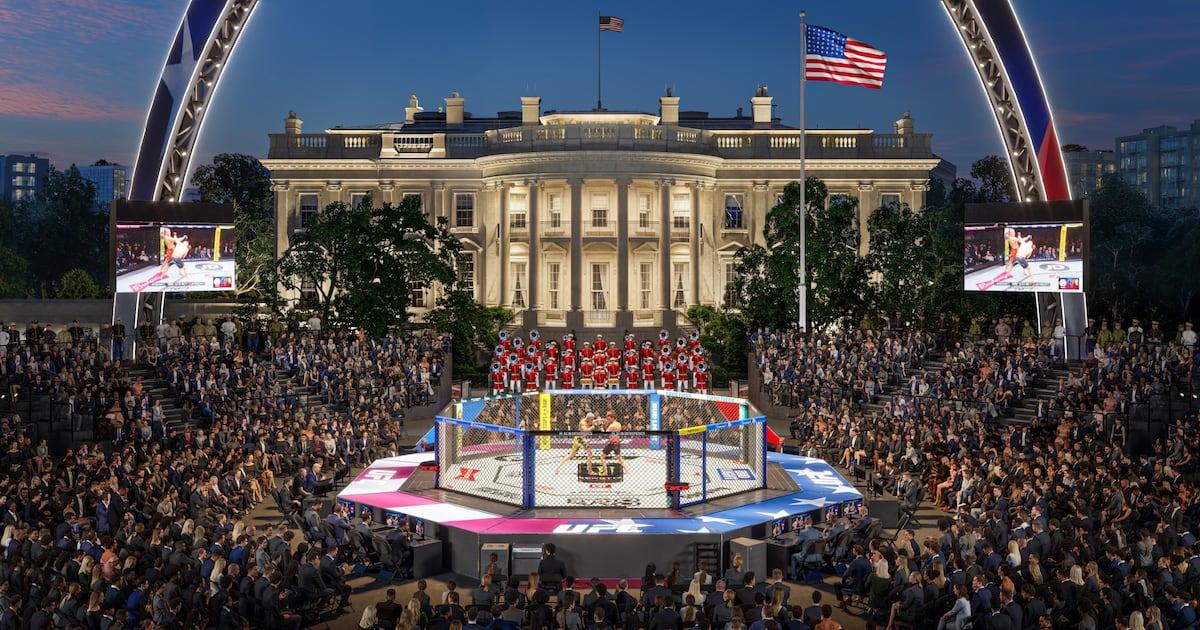
Cage Fight At The White House: When Politics Stepped Into the Octagon

NAIROBI, KENYA — The White House was transformed into an unlikely battleground as elite fighters stepped into the octagon for a UFC fight. What unfolded was more than just a night of combat sports; it was a striking fusion of entertainment, politics, and national symbolism that quickly became one of the most talked-about events in recent American history.
President Donald Trump hosted a full-scale Ultimate Fighting Championship event on the White House grounds. Timed alongside the United States’ 250th anniversary celebrations and coinciding with his 80th birthday, the spectacle drew thousands of spectators and captured global attention. Guests ranging from political allies to members of the military filled the venue, while crowds gathered beyond its perimeter, eager to witness the historic moment.
Inside the cage, the fights delivered the drama fans expected. High-stakes matchups produced decisive finishes, with one headline featuring a dramatic comeback victory that electrified the audience. The intensity inside the octagon was matched by the energy outside it, as patriotic displays, music, and ceremonial elements created an atmosphere that blended sport with national celebration.
Yet, the event’s significance extended far beyond the fights themselves. Almost immediately, it ignited a fierce public debate. Supporters hailed the night as a bold and uniquely American innovation, an event that brought people together while showcasing strength, resilience, and spectacle. For them, it was a celebration of culture and entertainment on a grand scale.
Critics, however, viewed it differently. They questioned the appropriateness of staging a commercial sporting event at a government residence, arguing that it blurred the line between public office and private enterprise. Legal challenges emerged in the lead-up to the event, and protests unfolded nearby, with demonstrators expressing concern over what they saw as the commercialization of a historic national symbol.
Despite these objections, the event went ahead, underscoring the deep divisions surrounding it. The contrast between roaring cheers inside the venue and dissenting voices outside highlighted a broader national conversation about the role of spectacle in politics and the boundaries of presidential authority.
In the end, the White House fight night became more than a sporting event, and it became a symbol of a moment. For some, it will be remembered as a groundbreaking celebration that redefined how politics can engage with popular culture. For others, it stands as a controversial episode that pushed the limits of tradition and decorum.
“I think it opens the doors to a lot of possibilities. It is we want the White House to be a place that connects with the American people. If events like this continue to inspire and unite people, then absolutely, it's something we could consider again," said President Trump in an interview.”
What remains undeniable is its impact. Like the fights it showcased, the event was intense, polarizing, and impossible to ignore and proving once again that in modern America, the arenas of politics and entertainment are closer than ever before.