
Raytheon Wins $25 Million Army Deal to Sustain Strategic Communications Terminal
The Fullerton, California, defense unit received a cost-plus-fixed-fee contract for depot repair and obsolescence sustainment of the AN/USC-28(V) terminal, with work running through July 30, 2031.

FULLERTON, CALIFORNIA — Raytheon Co., the largest U.S. defense unit of RTX Corp., won a $25 million Army contract to keep a strategic communications terminal running through the next decade.
The cost-plus-fixed-fee, indefinite-delivery/indefinite-quantity award covers depot-level repair, engineering and obsolescence sustainment of the AN/USC-28(V) strategic communications terminal, with an estimated completion date of July 30, 2031, as announced on war.gov.
Raytheon generated $26.8 billion in net sales during 2024 and employs more than 52,000 people across 58 countries, according to rtx.com. The Fullerton, California, unit sits inside RTX Corp., the parent formed when Raytheon merged with United Technologies Corporation in 2020 and adopted the RTX name in July 2023, according to rtx.com.
The Army Contracting Command at Aberdeen Proving Ground, Maryland, is the contracting activity under identifier W15P7T-26-D-A004. One bid was solicited and one was received, the Defense Department said in its daily contract digest. Work locations and funding will be determined with each order.
The award benefits the Pentagon by extending the service life of aging communications hardware rather than funding a full replacement. Depot-level repair and obsolescence sustainment work keeps parts flowing for equipment whose original components are no longer manufactured. That approach spreads spending across five years and shifts risk toward the contractor under the cost-plus-fixed-fee structure, which reimburses allowable costs and pays a set fee.
Raytheon traces its roots to 1922, when Vannevar Bush and two partners founded the company in Cambridge, Massachusetts, according to wikipedia.org. The firm built magnetron tubes and radar systems during World War II, then grew into the world’s largest producer of guided missiles. By 2015 it ranked as the third-largest U.S. defense contractor by defense revenue, according to wikipedia.org.
For the average U.S. reader, the contract carries no direct cost beyond the federal budget it draws from. Strategic communications terminals link command centers to deployed forces, and sustaining them supports the systems that underpin national defense networks. The daily impact is indirect, tied to the continuity of military communications rather than any consumer service.
Sole-source sustainment awards like this one are routine for the Pentagon. This has happened before, and it happens often, because a single manufacturer typically holds the technical data and tooling for legacy hardware. The single-bid outcome here reflects that pattern, where the original equipment maker is the only practical source for depot repair and parts.
The next decisions on this contract will come from Army program managers who issue individual delivery orders against the indefinite-delivery structure. Each order will define its own work location and funding. A specific date for the first order has not been announced.
Raytheon’s ties to military communications reach back more than eight decades, as happened before with earlier wartime programs. The company received a government contract to mass-produce magnetron tubes during World War II, then delivered complete radar sets and shipboard systems for submarine detection, according to wikipedia.org. Those early contracts, worth a fraction of today’s awards, established the engineering base that carried the firm from a Cambridge tube maker to a pillar of the U.S. defense industry.
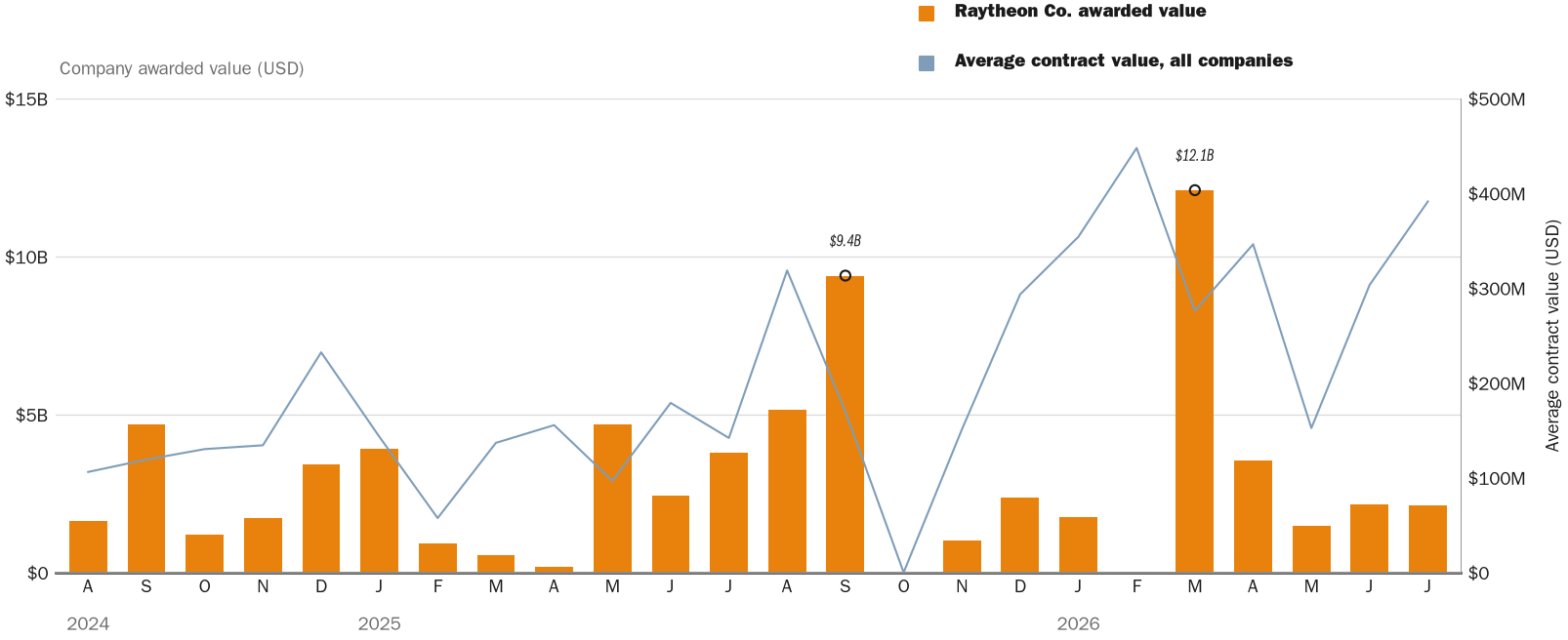

NewsFindr Chart Maker
Photo by NewsFindr Chart Maker

OpenTopoMap / Natural Earth – Fullerton, California
Photo by OpenTopoMap / Natural Earth – Fullerton, California