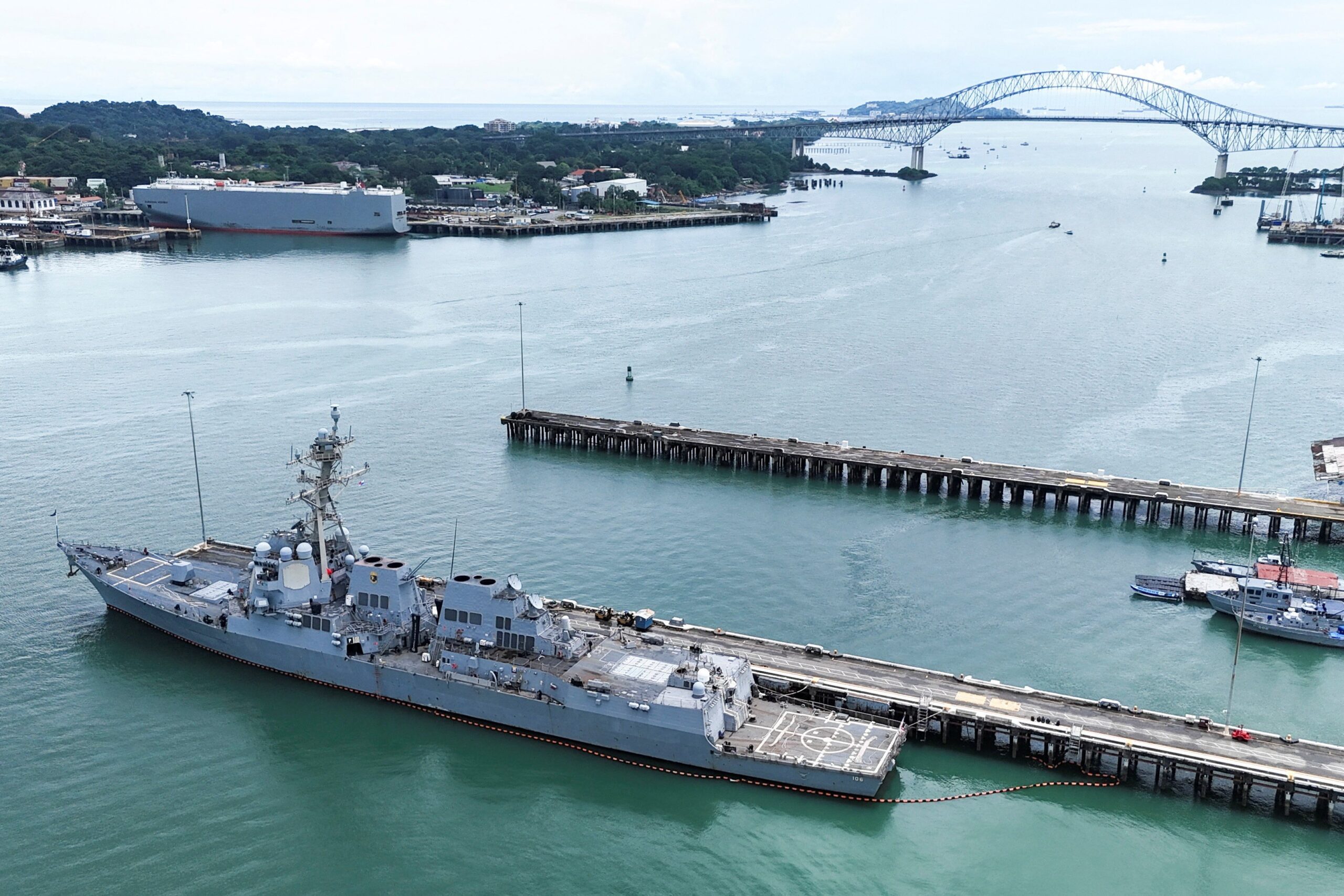
US Military Strikes Caribbean Vessel, Kills Two Suspected Narco-Terrorists
U.S. Southern Command says vessel was on trafficking route; rights groups describe killings as extrajudicial.

WASHINGTON — A U.S. military strike on a suspected drug trafficking vessel in the Caribbean killed two men on Sunday, while six others survived the attack.
The attack occurred on a boat traveling along a known trafficking route, according to a statement from U.S. Southern Command (SOUTHCOM). The military described the two dead as “male narco-terrorists” but did not identify the terrorist organizations it said operated the vessel. No U.S. forces were harmed.
The strike marks the third such lethal operation in the past week and the fourth this month. The strikes are part of Operation Southern Spear, a campaign carried out by Joint Task Force Southern Spear under the U.S. Southern Command, targeting vessels in both the Caribbean and Eastern Pacific that the administration alleges are linked to drug-trafficking organizations and cartels. The military has conducted more than 65 strikes, with the overall death toll exceeding 210 people.
The campaign has intensified under President Donald Trump, who has characterized major drug cartels in Latin America as terrorist organizations. On his first day in office, Trump signed an executive order permitting the designation of Latin American cartels and gangs as terrorist organizations. The list has since grown to 17 designated groups.
Historically, theU.S. Coast Guard interdicted suspected drug vessels through boarding, search and arrest, relying on judicial due process. The use of military force against drug boats represents a departure from that approach.
Rights groups have condemned the strikes as extrajudicial killings. Ben Soul, a United Nations (U.N.) special investigator on counterterrorism and human rights, has called Trump’s so-called war on narco-terrorism “phony.”
Democrats in Congress have demanded information about the operations. Last week, senators filed legislation that would pressure Defense Secretary Pete Hegseth to hand over unredacted documents and video concerning the attacks.
The Pentagon’s Office of Inspector General announced in May it was evaluating whether SOUTHCOM followed policies when attacking boats in the Pacific and Caribbean. That review remains ongoing.
From his desk at SOUTHCOM headquarters in Doral, Florida, Admiral Alvin B. Hasley reviewed the intelligence package forwarded from Joint Task Force Southern Spear. Satellite imagery, intercepted communications and pattern-of-life analysis placed the vessel on a known trafficking route.
“The intelligence was solid," said Hasley in an internal briefing.”
![Sailors assigned to the Combat Gunnery division aboard the Arleigh Burke -class guided missle destroyer USS Cole [DDG67] overseae a pre-caution calibration test fire in the Caribean Sea, July 10, 2025. Photo: Jonathan Word/U.S. Navy](https://staging.zenger.news/wp-content/uploads/2026/06/93c3fb92-6255-43ea-ba14-ffde2c36a92f_AC-1-1-1_2_-scaled.jpeg)

Sailors assigned to the Combat Gunnery division aboard the Arleigh Burke -class guided missle destroyer USS Cole [DDG67] overseae a pre-caution calibration test fire in the Caribean Sea, July 10, 2025. Photo: Jonathan Word/U.S. Navy
Hasley acknowledged the weight of the decision. Each strike means lives lost and families affected.
“Every time we pull the trigger, there are consequences. But the alternative letting those drugs reach our streets has consequences too,"said Hasley.”
The Trump administration defends the Caribbean strike as a necessary counter-narcotics and counterterrorism operation. Officials contend intelligence gave commanders lawful authority to strike, prioritizing disruption of narcotics flow over traditional due process.
Rights experts say the operation bypasses due process and violates maritime law. They argue it lacks group transparency and sets a dangerous precedent for military law enforcement.
The UN Convention on the Law of the Sea restricts deadly force against non-state vessels to situations involving imminent threat or active resistance, according to legal experts. Suspects were never charged, tried, or afforded legal representation in any of the strikes.
Taxpayers are funding a military campaign that has killed more than 210 people without a public accounting of the legal basis for each strike. The Pentagon inspector general’s evaluation remains ongoing.
“We are witnessing the normalization of military lethal force in what is essentially a law enforcement function. If this continues, the precedent could be used by other nations to justify similar extrajudicial actions against their own perceived enemies,"said Prof. Michael Becker ,an expert in international maritime law and human right at Trinity College Dublin .”
The Coast Guard completed its search-and-rescue operation Sunday, recovering all six survivors. Their identities and conditions remain unknown. The military has not released further details about the targeted vessel, its affiliation, or the names of those killed.
“The United States has long been a defender of the international rules-based order. These strikes undermine that fair order,"said Becker.”
The Pentagon inspector general’s evaluation continues. Congressional pressure is mounting. Whether the strikes continue and on what legal basis remains an open question.