
Army Lt. Gen. Brian S. Eifler Nominated for Third Star Post at Pentagon
The Army officer, now the service's top personnel officer as G-1, would move to run operations, plans and training as deputy chief of staff for G-3/5/7.

Army Lt. Gen. Brian S. Eifler was nominated to run the service’s operations, plans and training staff, one of the Army’s most influential posts.
Eifler, now the Army’s deputy chief of staff for personnel, would take over the G-3/5/7 directorate at the Pentagon in Washington, D.C., the Department of War said in a release dated July 16, 2026 according to war.gov. The nomination to the grade of lieutenant general moves a senior officer from managing manpower to steering current operations and long-range planning.
The G-3/5/7 role sits at the center of how the Army fights and prepares. The directorate oversees operations, plans, strategy and training across the force, shaping readiness and resource priorities. Moving from the G-1 personnel directorate to the G-3/5/7 shifts Eifler from managing soldiers to directing the missions those soldiers carry out.
Eifler most recently served as deputy chief of staff, G-1, where he encouraged Army leaders to support civilian deployments according to army.mil. The service maintains his biography and service record according to army.mil. The nominee’s prior assignments span troop leadership and headquarters staff work according to army.mil.
Senate confirmation stands between Eifler and the new post. Lieutenant general is a three-star grade, and appointments at that level require Senate approval, so the chamber’s Armed Services Committee and the full Senate hold the next decision. A date for a confirmation vote has not been announced.
The nomination arrives during a heavy season of senior-officer moves. It ranks among 109 officer nominations announced this year, with Hawaii leading all states at 10 and the Army carrying the most among the services at 74, according to the flag officer database. At the same point in 2025, the database recorded only 26 officer nominations.
For the average reader, the appointment reaches beyond Pentagon corridors. The G-3/5/7 helps decide where soldiers train, how units deploy and how the Army spends readiness dollars, choices that ripple through base communities and the families who live near them. Decisions made in that directorate influence which installations grow and which contract.
Has a personnel chief moved into the operations seat before? This has happened before. The Army routinely rotates its three-star staff principals among the deputy chief of staff directorates, and officers who run G-1 personnel work have moved to operational and planning roles as their careers advance. The pattern reflects a service that prizes breadth across manpower, logistics and operations before entrusting an officer with its highest commands.
Compared with the pace elsewhere in the force, the Army’s 74 nominations this year dwarf the tallies of smaller services and underscore how much of the Pentagon’s senior turnover flows through the largest branch.
Staff reshuffles at the Army’s headquarters carry weight that outlasts the officers who fill the chairs, as history shows. The modern general staff structure traces to the reforms of Secretary of War Elihu Root, who after the Spanish-American War of 1898 created the Army War College in 1901 and pushed through the General Staff Act of 1903, according to britannica.com. Root’s overhaul replaced a fractured bureau system with a unified staff meant to plan and direct operations. The reforms outlived Root, who left office in 1904, and set the template for the very directorate Eifler is now nominated to lead.
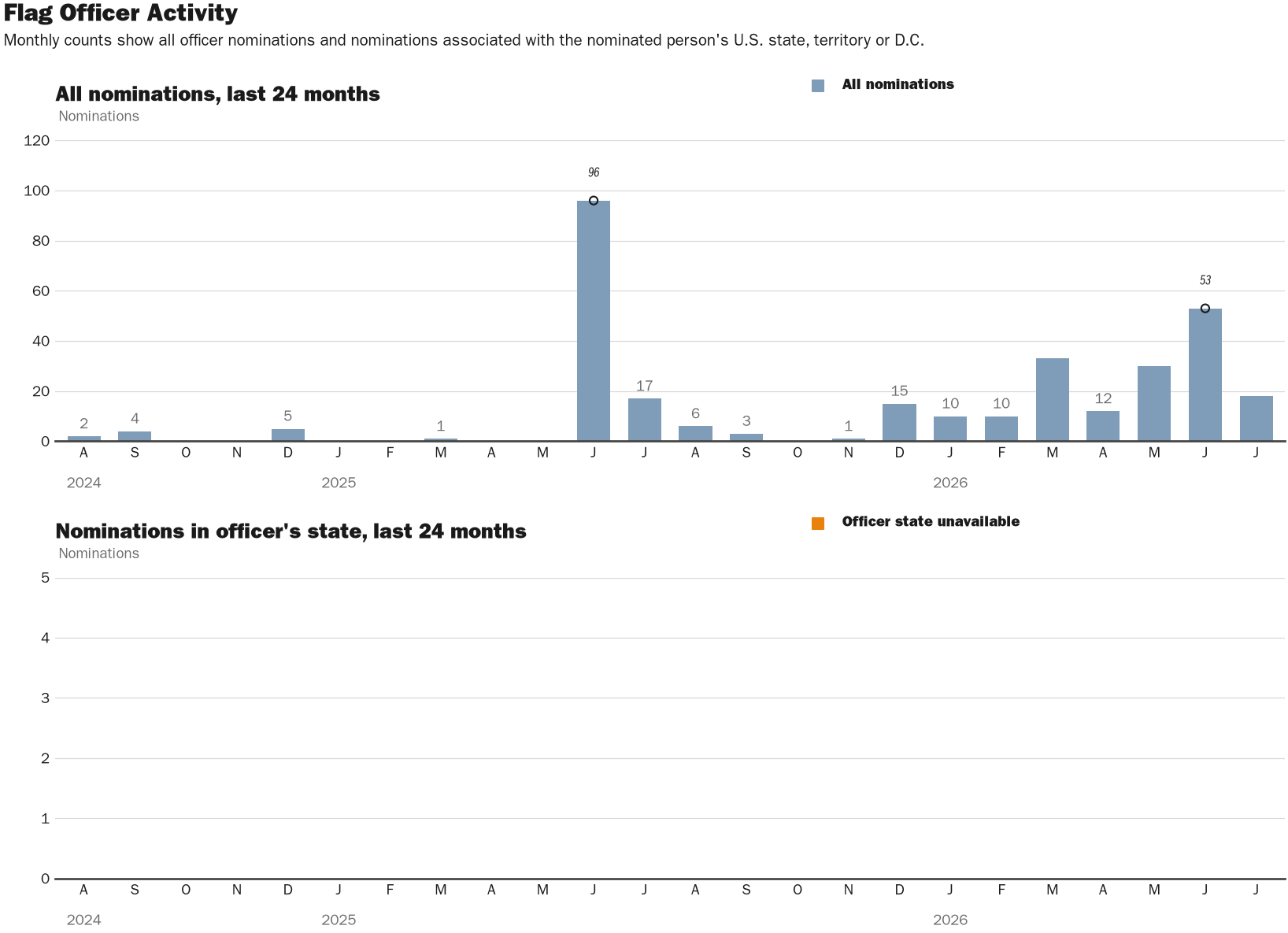

Source: NewsFindr Chart Maker
Note: Chart generated by NewsFindr on July 16, 2026 at 4:31 PM ET