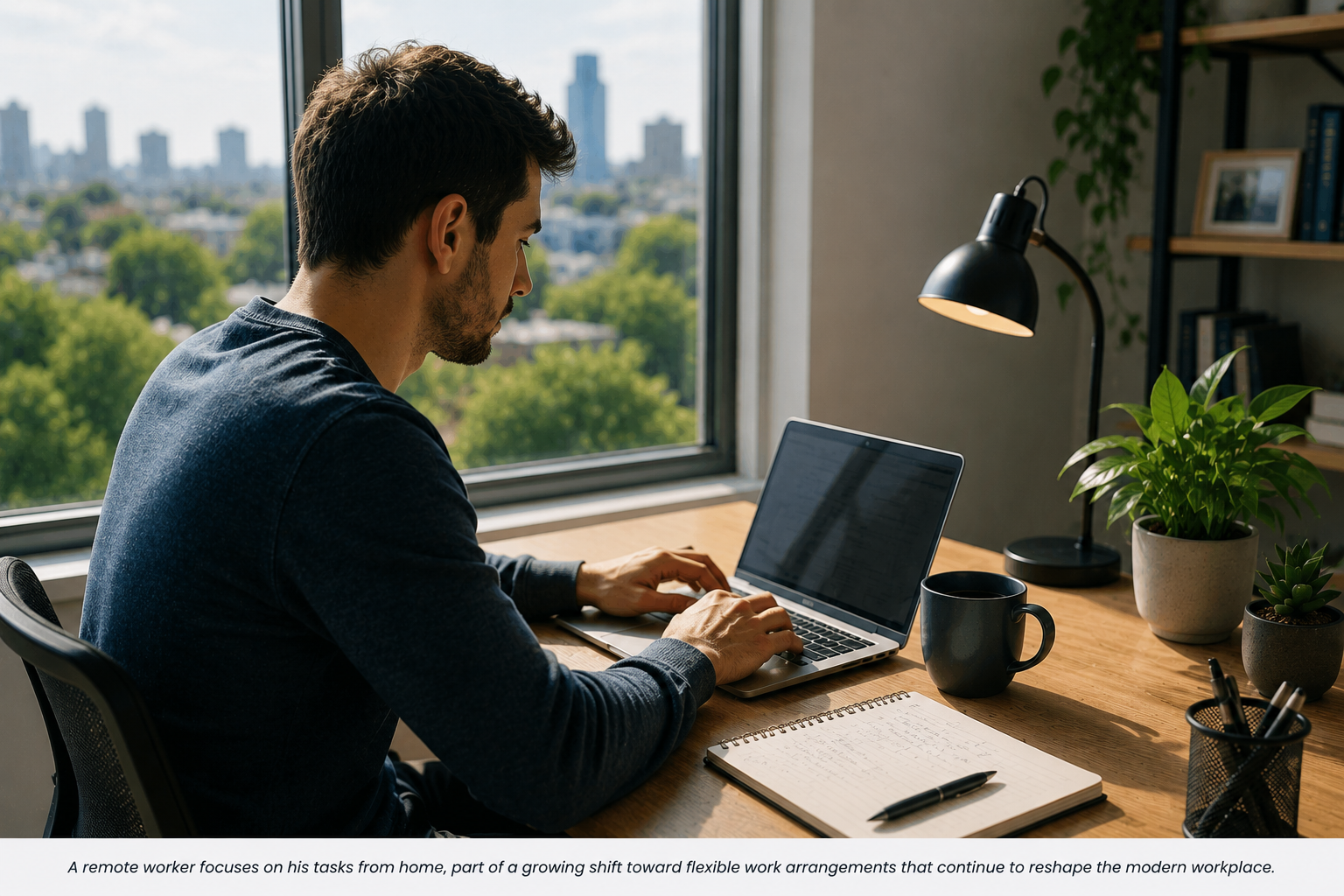
The remote work revolution continues.
Remote work has transformed how millions of people earn a living, offering greater flexibility and eliminating daily commutes. .

AFRICA, INDIANA — At 8 a.m. in Nairobi, a software developer logs into a video meeting with colleagues in London and New York without leaving home. Thousands of miles away, a marketing specialist works from a café while collaborating through cloud-based platforms and messaging apps. What began as an emergency response during the COVID-19 pandemic has evolved into a lasting workplace shift, with millions of employees worldwide continuing to work remotely or through hybrid arrangements. As companies balance employee demands for flexibility against concerns about productivity, collaboration, and workplace culture, a key question remains: Is remote work a temporary experiment, or has it permanently changed how the world works?
Christos A Makridis embodies the remote work trend through both his research and professional life. As an economist studying labor markets, artificial intelligence, and the future of work, he has closely examined how digital technologies are transforming where and how people work. Based in the United States, Makridis studies the benefits of remote work, including greater flexibility, access to wider talent pools, and improved productivity, while also highlighting challenges such as maintaining collaboration, innovation, and workplace culture. His work places him at the center of the debate over whether remote work is a permanent shift or a temporary adjustment.
The numbers suggest that remote work is no longer a temporary response to the COVID-19 pandemic but a lasting feature of the modern workplace. McKinsey & Company found that 20 to 25 percent of workers in advanced economies could work from home three to five days a week, representing four to five times more remote work than before the pandemic. At the same time, studies have highlighted challenges, including concerns about collaboration, workplace culture, and employee well-being, showing that while remote work is here to stay, organizations are still searching for the most effective balance between flexibility and in-person interaction.


Peter Lojore in Nairobi, June 24, 2026. The remote work revolution continues. Photo: Peter Lojore/Luna Studio. © lunalens studio 2026
Remote work has sparked a conflict between employees who want flexibility and employers who believe in-person work strengthens collaboration and company culture. Workers say remote jobs save commuting time and costs while improving work-life balance, whereas many business leaders worry that innovation, teamwork, and employee development suffer when people work apart. While companies can reduce office expenses and hire talent from anywhere, downtown businesses, commercial real estate owners, and transit systems often lose revenue when fewer workers commute. This tension has made remote work one of the most debated workplace trends, with researchers like Christos A. Makridis studying whether the benefits of flexibility outweigh the challenges of maintaining productivity and workplace connections.
To fully explore this trend, the story could include interviews with Christos A. Makridis, an economist and expert on the future of work; a company executive who supports return-to-office policies and can explain employer concerns about productivity and collaboration; and a remote employee whose daily life has been improved by flexible work arrangements. Together, these sources would present both sides of the debate and show how remote work affects businesses and workers differently. Looking ahead, experts expect hybrid work models to remain common as companies continue experimenting with the balance between flexibility and in-person collaboration. The key question for the future is not whether remote work will survive, but how workplaces will adapt as technology, employee expectations, and business needs continue to evolve.