
Bird-Johnson Awarded $98.7 Million Navy Deal to Overhaul Destroyer Propeller Hubs
The Walpole, Massachusetts, propulsion maker received a sole-source contract to refurbish controllable-pitch propeller hubs and oil distribution boxes, with work running through July 2029.

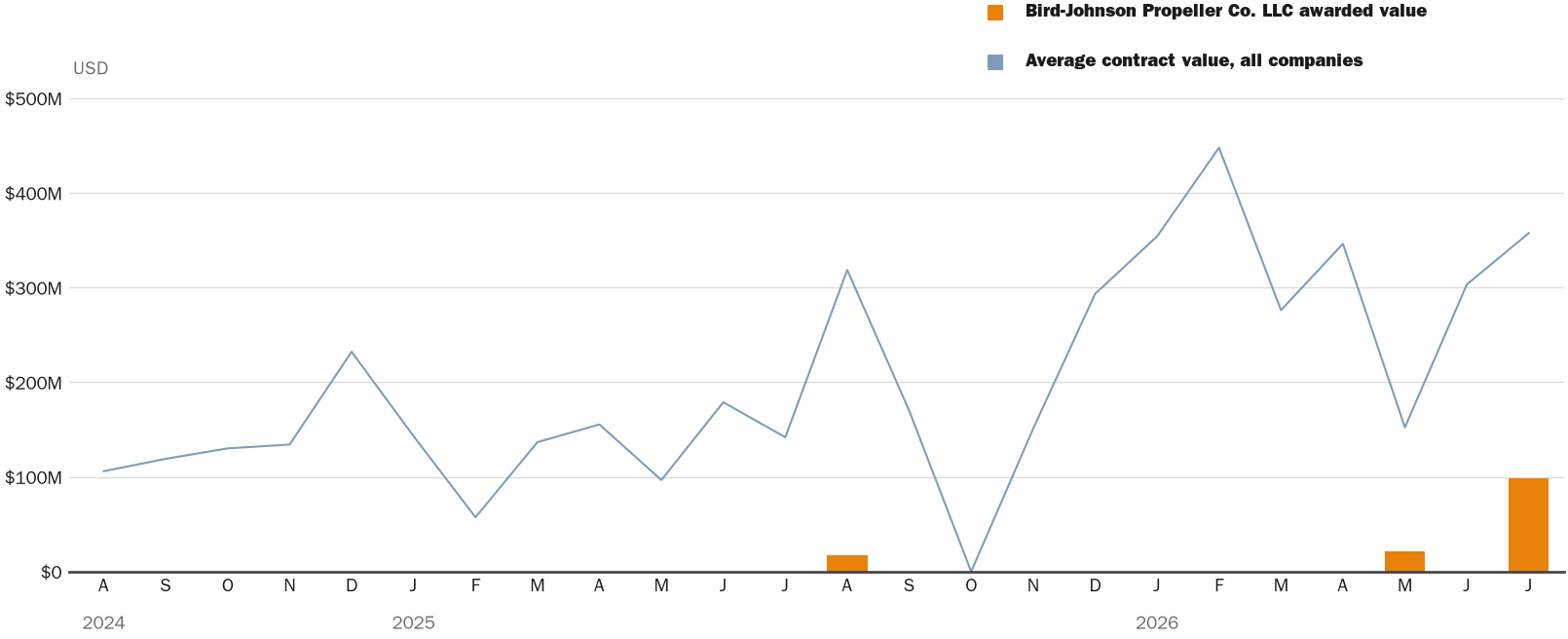
WALPOLE, MASSACHUSETTS — Bird-Johnson Propeller Co. LLC received a $98.7 million Navy contract to overhaul controllable-pitch propeller hubs and oil distribution boxes as the sole qualified supplier, as announced on war.gov.
The firm-fixed-price, indefinite-delivery contract covers commercial depot-level overhaul at the company’s Walpole, Massachusetts, plant, according to war.gov. The award obligated $362,706 through the first task order, with completion expected by July 2029. Fiscal 2026 operations and maintenance funds cover the initial obligation and expire at the end of the current fiscal year.
“We are honoured to power the US Navy’s flagship destroyer,” said Dan Rediger, power and propulsion president at Bird-Johnson Propellers, according to naval-technology.com. “Our controllable pitch propeller system has been a cornerstone of the DDG program’s success.”
The Navy skipped competitive bidding under 10 U.S. Code 3204(a)(1), citing one responsible source and no substitute able to satisfy its requirements, according to war.gov. Naval Surface Warfare Center Philadelphia Division serves as the contracting activity. Bird-Johnson has supplied controllable-pitch propeller systems for the DDG-51 Arleigh Burke-class destroyer since the program began, receiving its first contract 40 years ago, according to naval-technology.com. The Fairbanks Morse Defense subsidiary recently secured an order to supply propellers for the Navy’s 100th DDG-51 destroyer, a 9,000-ton warship built for anti-air, anti-submarine and anti-surface missions.
The overhaul work sustains readiness across much of the surface fleet. The company’s hubs and oil distribution boxes drive DDG-51 destroyers, Ticonderoga-class cruisers, San Antonio-class amphibious transport docks and other classes, according to highergov.com. A shortage of ready-for-issue propeller assets would slow maintenance cycles and idle ships at the pier, a risk the sole-source award aims to avoid.
The contract reflects Bird-Johnson’s rapid growth as a federal supplier. The company, organized in Delaware and headquartered in Walpole, was founded in July 2025 and has drawn more than $29.4 million in federal contracts, with the Department of the Navy accounting for 98% of that total, according to highergov.com. Ship and boat propulsion components make up 97% of its awards.
The overhaul rarely touches an ordinary consumer directly, yet it feeds the maintenance pipeline that keeps commissioned destroyers deployable, protecting the shipping lanes and carrier groups that underpin global trade.
Sole-source propeller work for the Navy has happened before. Bird-Johnson held a $70.2 million indefinite-delivery vehicle to repair CPP hubs and oil distribution boxes starting in 2020, and a separate $67 million CPP repair vehicle ran from 2020 to 2025, according to highergov.com. The new award extends a maintenance relationship spanning four decades.
Naval Surface Warfare Center Philadelphia Division will decide subsequent task orders as contracting actions occur, releasing funding at the task-order level. A date for the next task order has not been announced.
Controllable-pitch propellers reshaped naval propulsion long before the DDG-51 sailed. The design, refined for warships through the mid-20th century, let vessels vary thrust without reversing engines, according to naval-technology.com. Bird-Johnson traces its propeller lineage to that era, and its blades now spin beneath America-class amphibious assault ships and the destroyers that anchor the modern surface fleet.

NewsFindr Chart Maker
Photo by NewsFindr Chart Maker