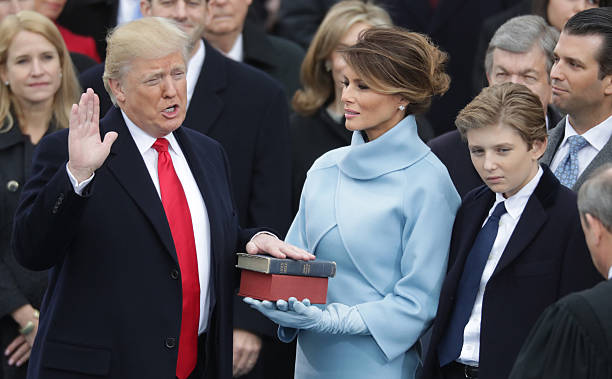
Trump reads Bible verses on repentance after AI image of himself as Jesus
Trump read a Bible passage about punishment and national repentance as part of a Republican-led marathon event. J By John…
Trump read a Bible passage about punishment and national repentance as part of a Republican-led marathon event.
NORTH AMERICA — President Donald Trump deleted an AI-generated image from his Truth Social account Monday morning after the post, depicting him in white robes, his hand glowing as he touched a sick man’s forehead, sparked a rare backlash from his own supporters.
Critics, including influential evangelical voices, called the image “blasphemous” and urged the president to remove it. Hours later, Trump defended the post in unusual terms: “I thought it was me as a doctor.”
For Trump, the line between politics and self-image has always been blurry, but the AI image represented a jarring new chapter in his long-running toying with messianic aesthetics. Speaking to reporters from the White House, he dismissed the controversy as a product of “fake news” and argued that his actions heal people. “I make people a lot better,” he said. Yet the episode laid bare a growing perception that Trump may be out of touch with his own religious base, a shift now backed by fresh data.
A new Pew Research Center survey conducted April 6–12, just before Trump attacked Pope Leo XIV and posted the image, found that 70% of U.S. adults now say Trump is “not too” or “not at all” religious, up eight points since October 2024. Among White evangelicals, a core constituency, just 5% view Trump as very religious, while 51% say he is “not too” or “not at all” religious. A separate Democracy Institute–Mirror US poll found that 57% of Christian Republicans did not believe Trump’s claim that the image showed him as a doctor rather than Jesus.
The backlash was swift and unusually bipartisan. Riley Gaines, a conservative activist who has worked closely with the White House, wrote on social media: “A little humility would serve him well. God shall not be mocked.” Christian activist Sean Feucht called the image “gross blasphemy” and warned, “Faith is not a prop.” Brilyn Hollyhand, former co-chair of the RNC’s Youth Advisory Council and a self-described “full-time Christian,” wrote: “This should be deleted immediately. There’s no context where this is acceptable.”
Behind the outrage lies a deeper tension. The image appeared less than an hour after Trump posted a lengthy criticism of Pope Leo XIV, the first American-born pontiff, whom he called “weak on crime” and “terrible for foreign policy.” The pope, who has repeatedly condemned the joint US-Israeli war in Iran, responded: “I have no fear of the Trump administration, or speaking out loudly the message of the Gospel.”
The controversy has now spilled into U.S. foreign policy. Secretary of State Marco Rubio is scheduled to visit the Vatican May 6–8 in an effort to ease rising tensions between the White House and the Holy See. For American Catholic taxpayers, roughly one in five U.S. adults, the diplomatic rupture raises questions about whether the White House’s religious rhetoric is undermining long-standing alliances. The U.S. Conference of Catholic Bishops has publicly defended the pope, and the Vatican’s ambassador to Washington has warned that continued attacks could damage “moral leadership” on global issues.
Patrick Basham, founding director of the Democracy Institute, told The Mirror: “Trump may retain almost God-like status among a good many MAGA voters, but he massively misread his audience when he visually portrayed himself as Jesus. Most Christian Republicans don’t buy his spin that he was portraying a doctor. This political own-goal is but the latest demonstration that Trump no longer has the Midas touch when communicating with religious conservatives.”
A week after deleting the image, Trump participated in a marathon Bible-reading event from the Oval Office, reciting a passage from 2 Chronicles 7:14 about national repentance and healing. Critics saw the timing as an attempt to repair damage with evangelicals. Whether the episode becomes a one-time stumble or a turning point in their once-unshakable support may depend on what happens next: Rubio’s Vatican trip, another Pew survey expected this spring, and whether the president can resist hitting “post” on sacred symbolism again.